In an increasingly volatile business environment, Supply Chain Finance (SCF) is evolving from a transactional working capital tool into a strategic enabler of ecosystem resilience and growth. For Megha Kaushik, GM & Head – Supply Chain Finance, Patanjali Foods Ltd., this transformation is deeply shaped by her dual grounding in banking and corporate finance. Bringing together risk discipline, digital integration, and value chain alignment, she views liquidity not as a safeguard in isolation, but as a synchronizing force that connects suppliers, distributors, and internal operations. In this conversation, she explores how FMCG organizations in India are redesigning working capital strategies amid demand volatility and tighter credit conditions, the role of automation and AI in enabling predictive finance, and how structured SCF frameworks can extend stability deep into Tier 2 and Tier 3 networks—turning finance into a driver of sustainable, system-wide growth.
You began your career in banking and now lead Supply Chain Finance in a large FMCG organization. How has this dual perspective shaped your approach to liquidity management across the value chain?
Megha Kaushik
Beginning my career in banking gave me a disciplined understanding of credit, risk evaluation, and capital allocation. I was trained to assess exposure conservatively and to view liquidity as a safeguard. Transitioning into the FMCG ecosystem expanded that lens. I began to see liquidity not merely as protection, but as a strategic enabler of growth across the value chain.
In banking, you evaluate risk from the outside. In corporate supply chain finance, you design structures from within. That shift fundamentally altered my approach. Liquidity management, in my view, is not about preserving cash in isolation — it is about ensuring that suppliers, distributors, and internal operations remain financially synchronized.
A defining phase in this evolution was leading digitization efforts, including the implementation of a Treasury Management System. Integrating digital supplier onboarding, automated workflows, and structured financing mechanisms created transparency across stakeholders. It demonstrated how technology can reduce friction, accelerate decision-making, and optimize working capital without compromising governance.
This dual exposure has taught me that supply chains function as interconnected financial ecosystems. When visibility improves and funding mechanisms are thoughtfully designed, liquidity becomes stabilizing rather than reactive. My approach today is anchored in building resilient structures where capital flows predictably, risk is anticipated early, and partnerships are strengthened through financial clarity.
In today’s environment, should Supply Chain Finance be viewed primarily as a working capital tool or as a strategic lever for ecosystem growth?
It would be reductive to see Supply Chain Finance as only one or the other. In practice, it evolves. At its foundation, Supply Chain Finance must begin as a working capital optimization mechanism. The immediate objective is to improve liquidity cycles, rationalize credit terms, and enhance cash flow predictability. Without this discipline, any broader ambition lacks structural stability.
However, once the fundamentals are in place — visibility, automation, credit governance, and stakeholder alignment — it naturally transitions into a strategic instrument. At that stage, it does more than release capital; it strengthens supplier relationships, enhances negotiating power, improves resilience during volatility, and enables scalable growth across the ecosystem.
Overemphasizing only the working capital angle can make it transactional. Treating it purely as a growth lever without financial rigor can introduce risk. The balance lies in sequencing — operational discipline first, strategic leverage next. When structured thoughtfully, Supply Chain Finance does not just optimize liquidity; it aligns incentives across the value chain and builds a more durable commercial ecosystem.
How are changing demand cycles and tighter credit conditions reshaping working capital strategies in FMCG?
FMCG demand cycles today are less predictable than they were a decade ago. Consumption patterns fluctuate faster, channel dynamics evolve rapidly, and credit conditions have become more disciplined. In such an environment, working capital strategy can no longer be static. What has changed significantly is the financial awareness across the value chain. Vendors, distributors, and retailers are far more informed about funding costs, credit structures, and opportunity trade-offs. Conversations are no longer limited to extending credit or negotiating payment terms; they now revolve around automation, cost of capital, structured financing models, and efficiency gains.
As credit tightens, the emphasis shifts from expansion to optimization. Companies are focusing on sharper receivables monitoring, calibrated inventory levels, and structured payables programs that balance liquidity with supplier stability. Automation plays a critical role here — eliminating manual interventions improves speed, transparency, and accuracy, which directly impacts working capital efficiency.
Tighter credit and volatile demand have forced FMCG organizations to move from reactive liquidity management to data-driven working capital design. The strategy today is less about stretching cycles and more about synchronizing them intelligently.
What are the foundational elements of a strong and scalable Supply Chain Finance framework?
A scalable Supply Chain Finance framework is built on three essentials: financial clarity, disciplined risk governance, and digital integration. Financial clarity ensures that the economics of the program — cost of capital, liquidity impact, and credit structure — are transparent and aligned across stakeholders. Without this, adoption remains superficial.
Equally important is structured risk management. Exposure limits, credit evaluation, and continuous monitoring must be embedded from the outset; scalability without risk discipline can quickly become vulnerability.
Finally, data integration is non-negotiable. A modern SCF framework must be automated, ERP-aligned, and supported by real-time visibility. Technology transforms it from a transactional tool into a resilient system. When these elements converge, Supply Chain Finance becomes not just efficient, but sustainable.
How do you design SCF programs that support suppliers and distributors without compromising on risk controls?
Designing an effective SCF program requires balancing commercial support with disciplined governance. The objective is not to dilute risk controls in the name of partnership, but to structure support intelligently.
My approach typically follows five principles.
First, technology integration. Programs must be embedded within core systems — ERP-linked workflows, automated approvals, and real-time exposure tracking reduce manual intervention and enhance control.
Second, data-led decision-making. Supplier segmentation, credit profiling, and transaction analytics allow differentiated structures rather than one-size-fits-all funding.
Third, structured risk architecture. Clear exposure limits, predefined eligibility criteria, and continuous monitoring ensure that liquidity support does not translate into unchecked credit risk.
Fourth, collaborative alignment. Suppliers and distributors should understand the commercial logic behind the program. When transparency exists, compliance improves naturally.
Finally, operational discipline. Defined processes, escalation mechanisms, and measurable KPIs ensure that the framework remains scalable and consistent.
A well-designed SCF program does not choose between growth and control — it integrates both. The strength lies in creating liquidity pathways that are predictable, monitored, and strategically aligned with the broader business model.
What structural interventions are most effective in reducing Days Sales Outstanding (DSO) sustainably?
Reducing DSO sustainably requires structural alignment rather than short-term collection drives. The focus must be on system design, not periodic pressure.
The first intervention is visibility. Real-time ERP integration and receivables dashboards allow early identification of aging patterns, credit utilization trends, and stress signals across channels. Without data transparency, DSO management becomes reactive.
Second is calibrated credit structuring. Credit limits, tenure, and incentives must be aligned with customer profiles and market realities. A uniform policy rarely works across diverse distributor networks.
Third, cross-functional coordination is critical. Finance cannot reduce DSO in isolation. Alignment with sales, logistics, and production ensures that dispatch decisions, scheme structures, and payment terms are synchronized with liquidity objectives.
Fourth, automation strengthens discipline. System-driven reminders, automated reconciliations, and approval workflows reduce delays caused by manual intervention.
Finally, proactive risk assessment ensures sustainability. Monitoring exposure trends, segment-level stress, and market volatility allows early corrective action before receivables deteriorate.
Sustainable DSO reduction is not about tightening credit abruptly; it is about creating a controlled, transparent, and coordinated receivables ecosystem where incentives and accountability are clearly defined.
How can companies build early-warning systems to prevent NPAs instead of reacting to them?
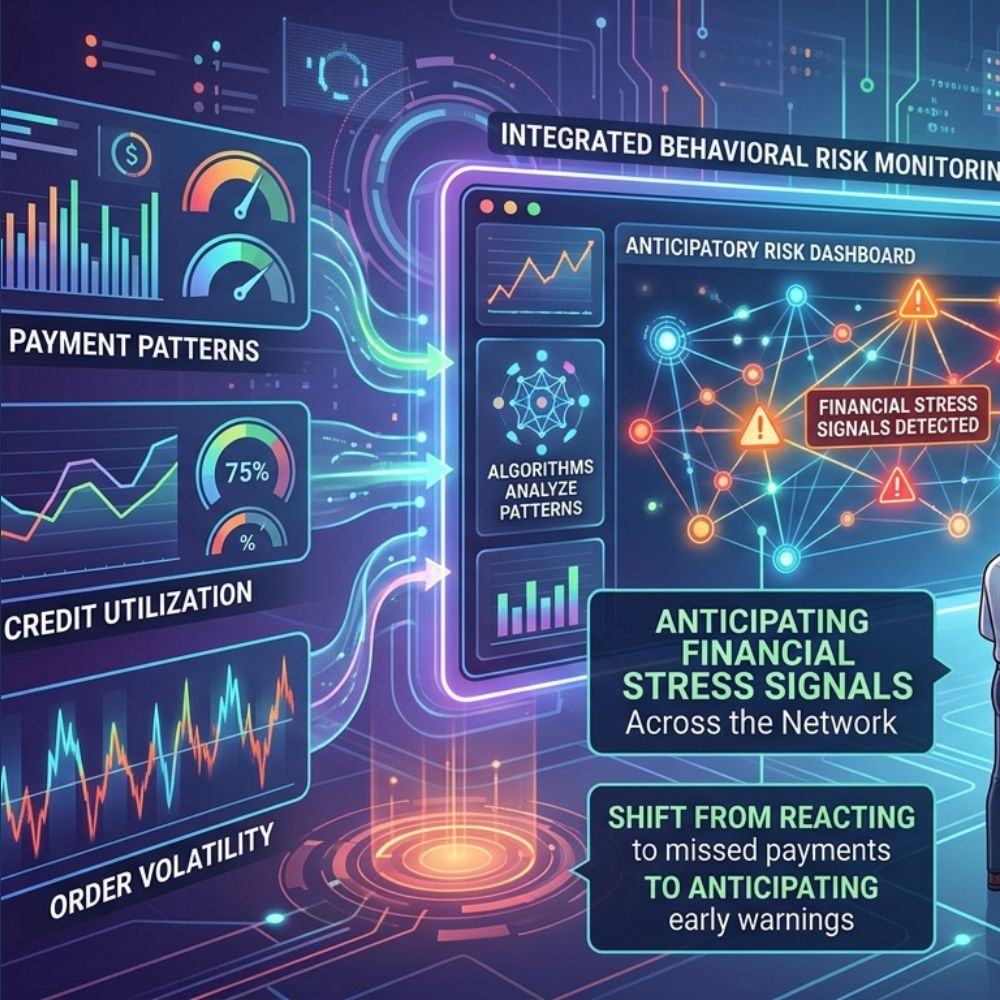
The objective of an early-warning system is not to predict the future with certainty — that is unrealistic. The objective is to detect stress patterns early enough to act before deterioration becomes irreversible. An effective framework begins with behavioral analytics. Monitoring payment frequency, payment slippages, order volatility, credit utilization spikes, and sales velocity across geographies provides leading indicators of stress within dealer and distributor networks.
Second, data integration is essential. Early-warning signals must be embedded within ERP and credit monitoring systems rather than reviewed manually. Automated triggers based on predefined thresholds ensure that exceptions are identified immediately.
Third, segmentation matters. Risk parameters should vary based on distributor scale, territory risk, and historical conduct. A uniform risk lens often fails to detect localized vulnerabilities.
Fourth, cross-functional escalation mechanisms must be clearly defined. Finance, sales, and regional teams should act collaboratively once stress indicators emerge. Early engagement with channel partners often prevents temporary liquidity constraints from becoming structural defaults.
Preventing NPAs is less about reacting to a missed payment and more about interpreting subtle financial behavior shifts over time. When systems are designed to capture these signals proactively, risk management becomes preventive rather than corrective.
You led the shift from manual payment systems to an SAP-integrated automated model. What were the biggest transformation challenges, and what changed structurally post-automation?
The most significant challenge in any automation initiative is not technological — it is behavioral. Transitioning from manual systems to an SAP-integrated framework required alignment across teams that were accustomed to legacy processes. Building confidence in the new system, addressing resistance to change, and pacing the transition carefully were critical to ensuring adoption.
Before implementation, we undertook a detailed business blueprint assessment, with particular focus on data hygiene and process mapping. Automation without clean data or clearly defined workflows only replicates inefficiencies at scale. Once the foundational architecture was clarified, the transition became significantly more structured.
Post-automation, the changes were structural rather than incremental. Receivables management became system-driven, with real-time tracking and automated reconciliation improving liquidity visibility and reducing DSO. A centralized funds transfer interface enhanced cash flow transparency, enabling more precise allocation and forecasting.
Operationally, automation reduced manual errors, shortened approval cycles, and improved processing efficiency — translating into measurable cost savings. Risk management also strengthened, with structured forex monitoring and hedging mechanisms embedded within the treasury framework to manage currency and interest rate exposure more proactively.
Perhaps most importantly, automation enabled the creation of a more integrated financial ecosystem — connecting banks, NBFCs, fintech partners, and internal stakeholders within a unified, transparent structure. The shift was not merely about digitizing payments; it was about redesigning the financial operating model to be scalable, resilient, and data-led.
How does ERP-linked automation strengthen negotiating power with suppliers and improve operational efficiency?
ERP-linked automation fundamentally shifts the quality of financial conversations with suppliers. When payment cycles, invoice validations, exposure limits, and cash forecasts are system-driven and transparent, discussions move from assumptions to data.
With real-time visibility into payables and liquidity positions, companies can design structured financing programs that offer suppliers predictability. Predictability reduces perceived risk. When suppliers are confident about payment timelines and funding access, negotiations evolve from defensive pricing to collaborative optimization. Automation also enhances internal efficiency. Approval hierarchies become streamlined, reconciliation cycles shorten, and manual intervention reduces significantly. This improves turnaround time while minimizing operational errors and disputes. Importantly, ERP integration enables early identification of stress signals — delayed dispatches, credit utilization spikes, or payment irregularities. Addressing these proactively prevents friction from escalating into supply disruption.
In essence, automation strengthens negotiating power not through pressure, but through credibility. When financial processes are transparent, disciplined, and data-backed, supplier relationships become more stable — and operational efficiency improves as a natural outcome.
Many companies invest in dashboards but struggle to extract strategic insight. How can tools like TABLEAU move beyond reporting to enable predictive decision-making?
Dashboards fail when they remain descriptive. Data, in isolation, rarely drives decisions. It must be contextualized, interpreted, and linked to action.
Tools like Tableau become strategic only when they move beyond displaying historical metrics and begin surfacing patterns, correlations, and emerging risks. Visualization is not merely about charts; it is about structuring information in a way that reveals direction.
The real shift happens when organizations transition from reporting ‘What Happened’ to analyzing ‘Why It Happened’ and ultimately projecting ‘What Is Likely To Happen Next’. When dashboards integrate trend analysis, variance triggers, cohort comparisons, and scenario simulations, they begin to support predictive decision-making rather than passive monitoring.
Equally important is narrative discipline. Insights must be aligned with business priorities — liquidity sensitivity, credit stress signals, demand fluctuations, or margin compression. When data is translated into business implications, leadership can act with clarity rather than instinct alone.
In essence, business intelligence tools deliver value not by accumulating data, but by converting information into foresight. The objective is not better reporting — it is better anticipation.
What role do AI-driven analytics play in improving credit evaluation and cash flow forecasting?
AI-powered analytics enhance both the quality and responsiveness of credit assessment and cash flow forecasting. Their true advantage, however, lies less in automation and more in their ability to detect patterns that may not be immediately apparent through conventional analysis.
Traditional credit models are largely anchored in historical financial statements and fixed exposure thresholds. In contrast, AI facilitates dynamic risk profiling by evaluating behavioral indicators such as payment consistency, transaction cadence, sales momentum, regional dispersion, and seasonal variations. This enables organizations to identify early warning signals before they surface in standard financial reports, shifting the focus from retrospective evaluation to proactive risk sensing.
In the context of cash flow forecasting, AI introduces greater accuracy by synthesizing diverse inputs simultaneously — including receivable cycles, payable schedules, consumption trends, currency volatility, and credit utilization levels. Forecasting thus evolves from static, linear projections to continuously refined scenario modeling, allowing liquidity planning to remain agile amid changing conditions.
That said, AI should serve as an enabler rather than a substitute for financial prudence. Established governance mechanisms, exposure controls, and disciplined credit frameworks remain indispensable. The real strength of AI lies in reinforcing human judgment through enhanced insight and faster detection of deviations.
When seamlessly integrated with ERP and treasury platforms, AI-driven analytics reposition finance from reactive analysis to forward-looking stewardship. The benefit extends beyond improved projection accuracy; it strengthens confidence in strategic capital deployment and risk management decisions.
How can Supply Chain Finance support Tier 2 and Tier 3 channel partners who often operate with limited financial buffers?
Supply Chain Finance initially evolved around Tier 1 partners, where financial documentation and credit visibility were relatively strong. However, in many industries — particularly FMCG — the product ultimately reaches the consumer through Tier 2 and Tier 3 intermediaries. If liquidity constraints exist at these levels, the efficiency of the broader SCF framework is inevitably affected.
In recent years, NBFCs and fintech institutions have increasingly focused on these segments, recognizing both the opportunity and the structural necessity of extending credit deeper into the distribution chain. While challenges such as limited documentation, collateral constraints, credit divergence, and geographic dispersion remain, these risks can be managed through structured mechanisms.
One approach is anchor-led financing, where the credibility of the primary corporate strengthens the credit profile of downstream partners. In some cases, lenders adopt controlled disbursement and collection models — such as linking loan servicing directly to mapped collection accounts — to reduce diversion risk. Collateral-backed structures, transaction-based lending, and invoice-level funding models also help mitigate exposure.
The key lies in designing credit programs that combine risk safeguards with operational simplicity. When Tier 2 and Tier 3 partners are provided structured liquidity access, the entire supply chain becomes more stable, predictable, and resilient.
Extending financial support beyond Tier 1 is not merely an inclusion strategy; it is a structural reinforcement of the distribution ecosystem.
In your experience, can SCF evolve into a self-sustaining or revenue-generating function? What mindset shift is required at the leadership level?
Supply Chain Finance can absolutely evolve into a self-sustaining — and in many cases revenue-accretive — function, provided it is designed intentionally rather than treated as a peripheral support tool. In the early stages, SCF is often viewed purely as a working capital optimization mechanism. However, once a structured framework is implemented, organizations begin to recognize measurable value creation: reduced leakages, improved cash cycle efficiency, optimized credit utilization, and lower dependency on conventional borrowing lines.
When liquidity is unlocked systematically, surplus funds can be deployed more strategically within treasury operations, generating additional yield. Over time, the SCF vertical can operate with defined metrics, cost efficiencies, and even a distinct performance contribution that is visible at the management reporting level.
The required leadership shift is conceptual. SCF must be viewed not as a side instrument but as a financial architecture embedded within the supply chain. It requires ownership, dedicated governance, and performance tracking — much like any other strategic function. Once leadership recognizes that every structured intervention in payables, receivables, and channel financing translates into measurable financial impact, SCF transitions from a facilitative role to a value-creating engine. In mature organizations, it is no longer optional — it is foundational to sustainable supply chain performance.
How important is cross-functional alignment between finance, procurement, and sales in unlocking capital efficiency?
Procurement, production, logistics, and sales form the operational backbone of the supply chain. Finance, however, is the liquidity engine that sustains it. Without alignment between these functions, capital efficiency remains theoretical. Working capital outcomes are rarely determined by finance alone. Credit terms are influenced by sales strategies, inventory levels by production planning, and payment cycles by procurement negotiations. If these decisions are made in silos, liquidity stress becomes inevitable.
Cross-functional alignment ensures that commercial ambition is matched with financial discipline. For example, extending credit to accelerate market penetration must be evaluated alongside cash flow implications. Similarly, procurement negotiations should balance cost savings with payment structures that preserve supplier stability.
From an SCF perspective, initiatives such as dynamic discounting, reverse factoring, ERP integration, and automated payment frameworks succeed only when all stakeholders operate within a synchronized structure. Shared KPIs, transparent data visibility, and collaborative planning are essential.
External partnerships with banks, NBFCs, and fintech institutions further strengthen this alignment by embedding structured funding solutions into the operational flow. Ultimately, capital efficiency is not unlocked by financial tools alone. It emerges when commercial strategy, operational execution, and liquidity management move in coordination rather than competition.
As supply chains become more digital and interconnected, what capabilities must the next-generation Supply Chain Finance leader build to stay ahead?
The next-generation Supply Chain Finance leader must operate at the intersection of finance, technology, and strategy. The role is no longer confined to optimizing payables or receivables — it demands architectural thinking.
First, technological fluency is non-negotiable. Leaders must understand automation frameworks, ERP-integrated ecosystems, AI-enabled analytics, and evolving fintech models. It is not about coding expertise, but about knowing how digital tools can be embedded into financial workflows to create transparency, speed, and scalability.
Second, there must be a deep understanding of dynamic funding structures. Traditional instruments are giving way to hybrid and structured solutions — dynamic discounting, platform-based financing, embedded lending, and risk-participation models. A modern SCF leader must continuously evaluate and recalibrate these mechanisms to suit changing market cycles.
Third, predictive analytical capability is critical. Data must move beyond reporting to foresight. The ability to interpret behavioral credit patterns, liquidity signals, and demand volatility through predictive models will differentiate proactive leaders from reactive ones.
Equally important is cross-functional orchestration. Siloed decision-making is incompatible with digital supply chains. Finance must collaborate seamlessly with procurement, sales, logistics, technology teams, and external financial partners to create synchronized capital strategies. Finally, risk intelligence must evolve. Volatility — whether geopolitical, currency-driven, or demand-led — requires structured mitigation tools, diversified funding channels, and disciplined governance frameworks.
The future SCF leader is not just a finance manager, but a systems thinker — someone who blends data, discipline, collaboration, and innovation to build resilient and adaptive financial ecosystems.
(Disclaimer: The views, opinions, and responses expressed in this document are personal and based on my individual professional experience. They do not represent or reflect the official position, policies, or views of my employer, its management, or any affiliated organizations. All information shared is intended solely for general discussion and knowledge-sharing purposes and does not disclose any confidential, proprietary, or sensitive business information. Any use, reproduction, or distribution of this material without the prior written consent of the author is not authorized, and the author assumes no liability for any outcomes, interpretations, or consequences arising from such unauthorized use.)


 Categories