In a business landscape defined by speed, scarcity, and continuous reinvention, the old playbooks no longer hold. Startups offer velocity, experimentation, and a bias for action; large enterprises bring scale, governance, and the ability to turn ideas into real impact. The future will belong to those who can bridge these two worlds with clarity of purpose and disciplined innovation. In this conversation, Akhil Srivastava, Senior Director – International Supply Chain, New Business Development & Innovation, ABInBev, unpacks how collaboration can become a true engine of value creation, why India is rapidly emerging as the world’s talent and capability hub for supply chains, and what kind of leadership mindset is required in an era where technology, sustainability, and values converge to redefine the very architecture of business.
As global supply chains undergo structural change, what shifts do you believe will redefine competitiveness over the next decade?
The most transformative shift will centre on people and leadership. As AI, ML, and even quantum technologies move from experimental to foundational, supply chain leaders will have to fundamentally rewire how they think. The traditional approach of driving performance through KPIs and backward-looking metrics will give way to a scenario-based, anticipatory mindset—one that evaluates capability, risk, and service through a dynamic, systems-wide lens. The vocabulary itself will change: from Available-to-Promise to Capable-to-Serve, where organisations balance customer expectations with constraints, opportunities, and real-time trade-offs.
This evolution extends to the C-suite as well. Leadership models will shift from revenue-led decision-making to optimization-led governance— where cost, service, sustainability, resilience, and speed are orchestrated together rather than managed in silos. In the decade ahead, supply chains will transition from linear, functional structures to interconnected, intelligent ecosystems powered by real-time data, predictive analytics, and adaptive networks. Competitiveness will no longer be defined by who moves goods fastest, but by who can sense, decide, and respond with the greatest precision, agility, and sustainability.
In an environment where disruption is the new normal, how do you balance short-term adaptability with long-term strategic resilience?
The traditional SCOR model—Plan, Source, Make, Deliver, and Return—is itself undergoing a reinvention. New technology providers and consulting players are accelerating a shift from inside-out supply chain thinking (driven by internal efficiencies) to outside-in thinking (driven by customer behaviour, market signals, and ecosystem dynamics). In this new context, adaptability is no longer a differentiator; it becomes the baseline expectation.
Balancing immediate agility with long-term resilience requires reimagining organizational structures. Companies must blend technology with human capability—using digital tools to sense disruption quickly while empowering talent to make informed, strategic decisions. Over time, resilient supply chains will be built on integrated technology stacks that place agility, automation, transparency, advanced analytics, and centralized orchestration at the core of organizational strategy. The future belongs to enterprises that can pivot rapidly in the short term while simultaneously building the structural intelligence required to thrive in a permanently volatile world.
How do you ensure that innovation moves beyond pilots and becomes embedded in core business operations?
For innovation to truly scale, organisations must begin with deep understanding—of customer needs (both expressed and latent), of the organisation’s purpose, and of the product’s full life cycle, including competitive dynamics. Too often, companies focus prematurely on the what and the how: What should we innovate? How do we scale it profitably? This leads to pilots that look promising in isolation but fail to integrate into the operating core.
The real pivot point is the why— Why is this innovation necessary? What customer friction, strategic gap or future opportunity does it address? When the organisation aligns around a clear, compelling “why,” the “what” and “how” naturally follow as execution outcomes, not decision starting points.
Embedding innovation into the business requires treating it not as an experiment but as a strategic capability— anchored in purpose, validated by customer insight, measured through full life cycle impact, and reinforced by leadership commitment. When these elements converge, innovation transitions from pilot to practice, and from isolated success to profitable, sustainable scale.
Among the technologies you’ve worked with, which have truly moved the needle for end-to-end visibility, collaboration, or cost optimization?
Several technologies show strong promise today, but AI—and soon, quantum-enabled tools—are decisively reshaping the landscape. What makes AI uniquely transformative is not just better algorithms, but the extraordinary surge in computational power behind them. Over the past decade, the compute required to train leading AI models has grown exponentially, increasing by several orders of magnitude. This has allowed models to process far larger datasets, learn with exceptional accuracy, and generate insights at speeds that were unthinkable a few years ago.
This computational leap is the fundamental reason AI systems improve so rapidly. Training cycles that once took years now take months; refinement cycles that took months now take weeks. As a result, AI-powered planning platforms, visibility layers, and decision-intelligence engines can now sense disruptions earlier, run richer scenario simulations, and optimize trade-offs across cost, service, and risk in real time.
For supply chains, this means a structural shift—from reactive, KPI-based execution to predictive, scenario-based orchestration. As quantum capabilities mature, they will further accelerate optimization at scale, solving complex network problems in seconds rather than hours. Together, AI and quantum technologies are moving the needle more than any other innovation, enabling organizations to improve visibility, enhance cross-functional collaboration, and unlock meaningful cost efficiencies across the end-to-end value chain.
How do you translate design-thinking principles into tangible operational improvements at scale?
The heart of design thinking lies in its bias for action: move fast, test early, and iterate relentlessly. Applying this in operations means starting with a Minimum Viable Product, validating assumptions quickly, and refining solutions based on real user behaviour. The ‘Fail Fast’ mindset isn’t about failure—it’s about accelerating learning cycles and reducing the cost of experimentation.
The real engine of impact, however, is EMPATHY. Deeply understanding user stories, frontline constraints, and operational pain points becomes the most critical control point. When teams continuously iterate and test with real users—from planners to plant operators to logistics partners—they co-create solutions that are intuitive, scalable, and genuinely transformative. This approach bridges the gap between innovation and execution, ensuring that new ideas don’t stay conceptual but translate into operational improvements at scale.
What are the most critical levers today for optimizing manufacturing and distribution networks in high-growth, high-volatility markets?
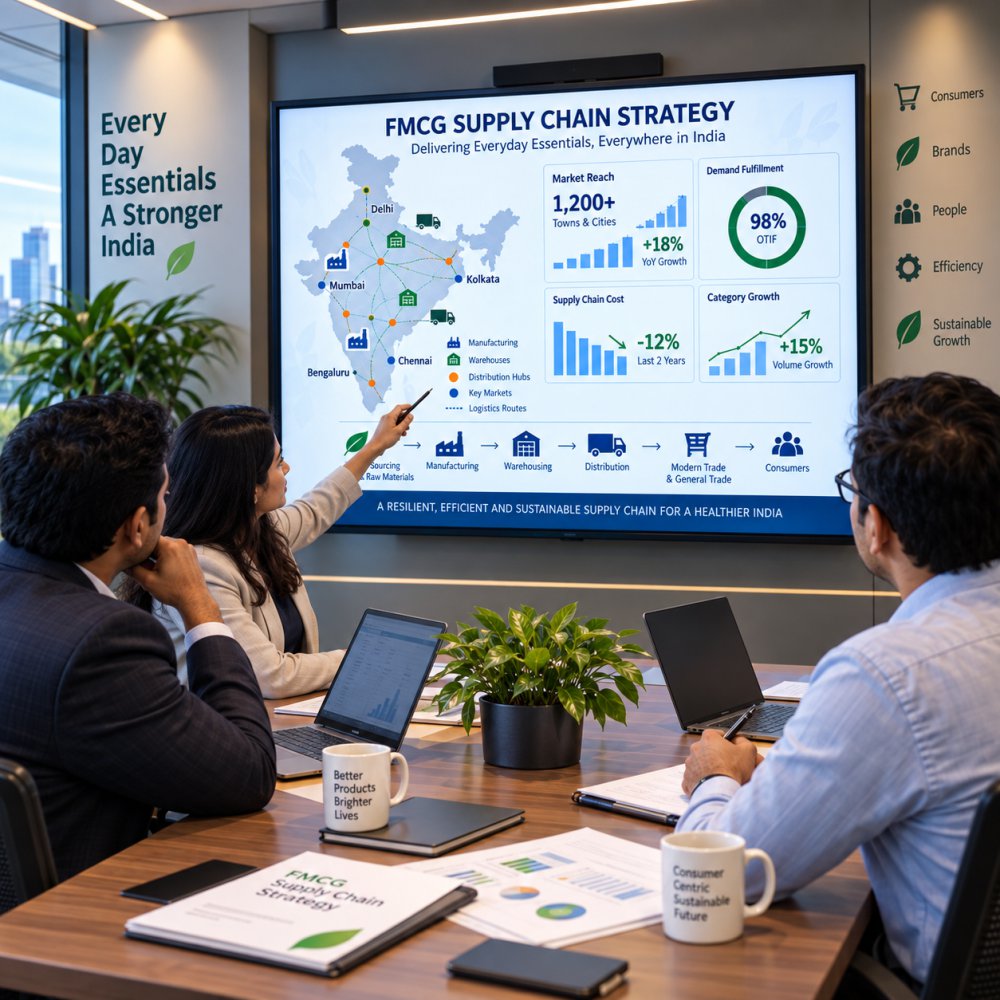
In today’s environment, optimizing manufacturing and distribution networks requires a single, strategic foundation: a strong digital core that enables an interconnected supply chain. The more real-time intelligence an organisation has, the more responsive, productive, and profitable the network becomes.
The essential capabilities include:
- Network visibility across plants, warehouses, logistics, and last mile
- Extended connectivity into suppliers and customers for shared decision-making
- Continuous learning, allowing the system to recommend optimal actions
- Intelligent resource deployment, whether human or machine
- Proactive operations, driven by predictive signals rather than reactive workflows
Leading organizations are weaving these capabilities into holistic networks built around:
- Sensing: Detecting market, demand, and operational shifts early.
- Forward Views: Generating predictive insights and managing risks proactively.
- Intelligent Collaboration: Using virtual command centres for real-time decisions.
- Synchronized Planning: Automating plan adjustments based on live signals.
- Immersive Visualization: Turning enterprise data into interactive, actionable environments.
- Cognitive Optimization: Enhancing network decisions using AI and advanced analytics.
- Intelligent Pricing: Leveraging cost-to-serve visibility to optimise margins.
- Dynamic Fulfilment: Reallocating inventory and shipments based on demand and risk.
- Robotics & Automation: Improving speed and accuracy across planning, logistics, and warehouse operations.
- Collaborative Ecosystems: Integrating suppliers, partners, and technology providers into a seamless digital network.
In high-growth and high-volatility markets, these capabilities turn supply chains from linear functions into intelligent, synchronized ecosystems— able to sense, respond, and optimize at the speed of change.
What new roles and skills are emerging as supply chains become increasingly digital and data-led?
As supply chains become more digital, it’s becoming clear that technology alone delivers only a small portion of the transformation value—perhaps 10%. Around 30% depends on process definition and standardization. But the remaining 60%—the true determinant of success—rests on change management.
This is why the most critical emerging role is that of a Change Leader: someone who can steer organisations through technological, cultural, and operational shifts with clarity and conviction. These leaders require a 360-degree understanding of the value chain, the ability to interpret real-time data, and the judgement to make cross-functional decisions at speed.
Beyond technical fluency, the next generation of supply chain professionals must excel in narrative economics— crafting compelling stories that help teams understand why the change matters and how it advances the organisation’s purpose. As Gandhi said, “Be the change you want to see”—and in the digital era, this means fostering a culture where people are empowered, informed, and aligned to drive transformation from within. The future supply chain will be built not only on AI, data, and automation, but on leaders who can orchestrate change with empathy, foresight, and behavioural intelligence.
What practices help build cross-functional teams that are both agile and innovation-driven?
Agile, innovation-driven teams emerge when organisations shift their focus from what to build and how to deliver, to a deeper understanding of why the innovation matters. Purpose becomes the unifying force that aligns diverse functions around a shared outcome.
A critical enabler is a strong PMO or transformation lead who brings robust change-management capability. This role helps dismantle silos, eliminates “over-the-wall” development, and replaces it with 360-degree design thinking. By grounding the work in user stories and real operational contexts, teams can co-develop solutions through iterative experimentation rather than linear handoffs.
The result is an organization that doesn’t just deliver projects—it builds products, experiences, and capabilities that endure. When cross-functional teams operate with clarity of purpose, a shared understanding of the user, and continuous iteration, they create innovations that stand the test of time.
How do you approach identifying and scaling new business models or adjacencies that align with long-term organizational goals?
Scaling new business models starts with a simple principle: a thousand-mile journey begins with a single step, but momentum must never slow. Organisations need to maintain consistent action, guided not only by the end vision but by alignment with their purpose—the why of their existence. A product or service is just the entry point. What truly matters is the ability to retain, grow, and evolve with the consumer over time. That is why identifying adjacencies must start with deeply understanding customer behaviour, emerging needs, and lifetime value—not just market gaps.
Every member across the extended value chain must embrace this journey with a customer-centric mindset and a commitment to continuous improvement. When the organisation is aligned around purpose, disciplined in execution, and focused on long-term value creation, new business models naturally scale in a profitable and sustainable way.
As someone who’s also engaged with startups and venture ecosystems, what qualities do you look for in founders and early-stage ventures?
The two non-negotiable traits are hunger to create value and passion anchored in purpose. If either of these fades— overshadowed by short-term priorities like chasing valuations, shareholder expectations, or the allure of a perfect hockey-stick curve—the venture is at risk of entering the “Death Valley” of startups. Founders must maintain an unwavering focus on the customer and the value they are trying to create. But they must also build a team of capable, empowered professionals who can run daily operations, allowing the founder to focus on vision, customer insight, and strategic growth. When founders lose hunger or clarity of purpose, the organization loses its customer. But when they stay committed, curious, and value-driven, they can build ventures that not only survive but scale with resilience and integrity.
How can large organizations and startups better collaborate to accelerate innovation across the value chain?
Large enterprises and startups bring complementary strengths to the table. Startups operate with speed, minimal bureaucracy, and high adaptability, enabling them to experiment rapidly and iterate without structural constraints. Large organizations, on the other hand, offer scale, resources, deep domain expertise, and a strong network effect across the value chain.
When a proof of concept succeeds, it creates a bridge where the startup’s agility meets the enterprise’s capacity to scale. This partnership can unlock rapid, enterprise-grade innovation and create powerful success narratives. However, one caution is critical: alignment of purpose and values. If a startup’s mission, ethics, or priorities diverge from those of the enterprise, the collaboration may result in a successful POC but a failed deployment. Sustainable partnerships require cultural compatibility, shared intent, and a long-term view of what success looks like for both sides.
What role do you see India playing in shaping the next wave of supply chain transformation across Asia and beyond?
India is uniquely positioned to shape the future of global supply chains. At a time when many large economies are facing demographic decline, India offers one of the world’s largest pools of young, skilled, English-speaking, and digitally fluent talent. This workforce brings a rare combination of grit, frugality, and creative problem-solving—qualities that are essential for modern supply chain transformation.
As global companies rethink operating models, India is increasingly becoming the hub for global capability centers, digital command centers, and AI-led supply chain operations. The Indian approach to design thinking—grounded in resourcefulness and customer-centricity—enables organisations to co-create innovative, cost-effective, and scalable solutions. Both government and industry have a significant opportunity to double down on Indian talent and infrastructure, positioning the country as the engine of the next phase of supply chain resilience and transformation across Asia and the world.
How is the definition of leadership itself changing in an era where technology, sustainability, and purpose intersect?
Leadership today is being redefined around purpose, adaptability, and continual reinvention. Technology is evolving at a pace that demands leaders who can unlearn and relearn constantly, navigate uncertainty with clarity, and align teams around a shared mission. Sustainability and purpose are no longer peripheral—they are central to decision-making and long-term value creation. Modern leaders must balance performance with responsibility, ensuring that business growth is both ethically grounded and environmentally conscious.
The speed of change now tests a leader’s ability to recycle learning quickly, challenge the status quo, and build resilient ecosystems that can absorb disruption while continuing to innovate. In this new era, leaders succeed not by knowing all the answers but by cultivating curiosity, empowering diverse teams, and steering organizations with conviction, humility, and future-focused purpose.


 Categories